
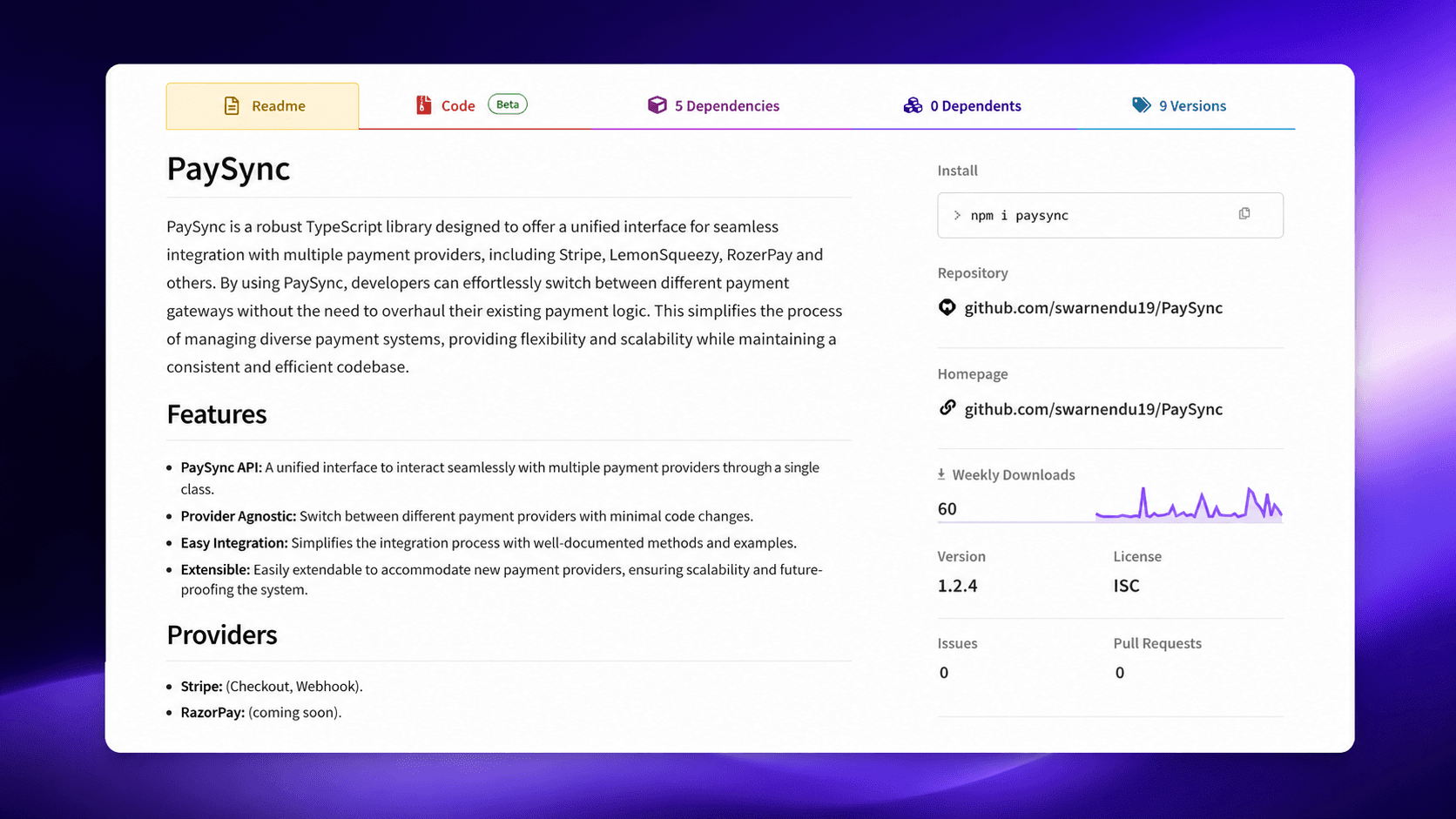
PaySync
A unified payment gateway SDK that provides a single API for integrating multiple payment providers with minimal code changes.
Timeline
2026
Role
Backend Developer
Team
Solo
Status
CompletedTechnology Stack
Key Challenges
- Unified Payment Interface
- Gateway Abstraction
- Webhook Standardization
Key Learnings
- Payment Gateway Architecture
- SDK Development
- API Design
PaySync: Unified Payment Gateway SDK
Overview
PaySync is an open-source NPM package that provides a unified interface for integrating multiple payment gateways into applications. Instead of learning and maintaining separate SDKs for every provider, developers integrate PaySync once and can easily switch or add payment gateways with minimal code changes.
The package abstracts provider-specific implementations behind a common API, making payment integrations cleaner, scalable, and easier to maintain.
Key Features
Unified Payment API
- Single interface for multiple payment providers.
- Consistent request and response format.
- Easy provider switching without changing business logic.
- Clean TypeScript-first developer experience.
Supported Payment Providers
- Stripe
- Razorpay
- PayPal
- Extensible architecture for adding additional gateways.
Core Features
- Create payment orders
- Capture payments
- Verify payment signatures
- Refund payments
- Fetch payment details
- Webhook handling
- Customer management
- Environment configuration
- Built-in validation
- Type-safe API
Why I Built This
Every payment provider has its own SDK, request format, authentication method, and webhook implementation. Supporting multiple gateways often leads to duplicated code and vendor lock-in.
PaySync solves these problems by providing:
- One integration for multiple gateways
- Standardized payment APIs
- Easier migration between providers
- Cleaner backend architecture
- Reduced maintenance cost
- Better developer experience
Package Architecture
Core SDK
- Unified payment interface
- Gateway abstraction layer
- Common request models
- Shared response format
- TypeScript support
- Plugin-based provider architecture
Gateway Adapters
Each payment provider implements the same interface, allowing applications to switch providers without changing business logic.
Examples include:
- Stripe Adapter
- Razorpay Adapter
- PayPal Adapter
Webhook Module
- Unified webhook verification
- Standardized event parsing
- Provider-specific signature validation
- Common webhook event objects
Developer Experience
PaySync is designed to minimize integration effort:
- Install one package
- Configure API keys
- Select a payment provider
- Start processing payments using a consistent API
Developers no longer need to memorize different SDKs or rewrite payment logic when switching providers.
Technical Challenges
Challenge 1: Gateway Abstraction
- Problem: Every payment provider exposes completely different APIs.
- Solution: Designed a common interface that abstracts provider-specific implementations while preserving advanced capabilities.
Challenge 2: Webhook Standardization
- Problem: Every gateway sends different webhook payloads.
- Solution: Built a unified webhook parser with provider-specific adapters.
Challenge 3: Extensibility
- Problem: Supporting new payment providers without breaking existing integrations.
- Solution: Implemented a modular adapter architecture that allows new gateways to plug into the SDK with minimal effort.
Performance Optimizations
- Lightweight package with minimal dependencies.
- Tree-shakeable modules.
- Lazy initialization of payment providers.
- Optimized TypeScript types for faster development.
- Efficient webhook verification pipeline.
Future Improvements
- Support for 20+ payment gateways
- Subscription billing APIs
- Marketplace payment support
- Multi-currency utilities
- Payment analytics module
- Built-in retry mechanisms
- Fraud detection integrations
- Checkout UI components
- Serverless adapters
- Official NestJS and Express plugins